How to Solve Nurikabe: Islands, Walls and the 2x2 Rule
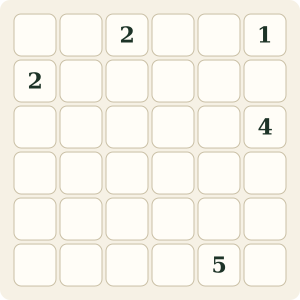
In Nurikabe some squares carry a number. That number is the size of an island: a connected group of that many squares, containing exactly one number. You shade every remaining square as the wall, under three rules:
- Each island holds one number, and its size equals that number.
- The wall is a single connected piece.
- The wall never contains a 2x2 block (no "pools").
Deduction 1: seal the ones
A 1 is an island of a single square, so all of its neighbors are walls (direct neighbors, not diagonal). Shade these first.
Deduction 2: squares between two islands
If a square touches two different numbers, or sits between two so that it would join their islands, it must be wall. The same goes for the two squares shared by numbered ones that touch diagonally.
Deduction 3: unreachable squares
Any square too far from every number to be part of its island is wall. Count steps: for example, a 3 can reach squares at most two steps away.
Deduction 4: no pools
If three squares of a 2x2 block are already wall, the fourth must belong to an island, since a 2x2 block all squares is against the rules. This is the rule that grows islands in open space.
Deduction 5: keep the wall connected
If the wall squares would be cut into two groups, an island must not close the gap. Whenever a single square is the only path between two wall regions, it is wall, because all wall squares must be connected.
Try a real one
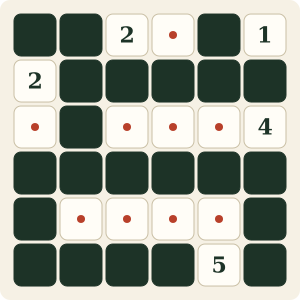
This 6x6 has one solution only. Start with the 1 in the top right corner (Deduction 1), then see how far Deduction 4 takes you in the open middle.
Show the solution
Where beginners slip
Finishing the islands before the wall is checked is the usual mistake. If the wall is not continuous or contains a pool (2x2 block), an island is the wrong shape. Fix the island, not the wall.
The Nurikabe app teaches these steps with a guided tutorial and ends on a puzzle with hints if you get stuck.
Related articles
Help Me Choose a Game
Not sure which logic puzzle to try? Answer two or three quick questions and get a suggestion from Hitori, Nurikabe, Norinori and Shikaku.
Read more
Hitori, Nurikabe or Norinori: Which Should You Learn First?
Three shade-the-squares puzzles, three different ways of thinking. How they compare, and which one to start with depending on how you like to solve.
Read more
Hitori, Nurikabe and Norinori: Three Puzzles from Japan
Where the names come from and when each puzzle first appeared in print. All three are shade-the-squares puzzles from the Japanese publisher Nikoli.
Read more
Comments (0)
No comments yet.