How to Solve Hitori: Four Moves That Do Most of the Work
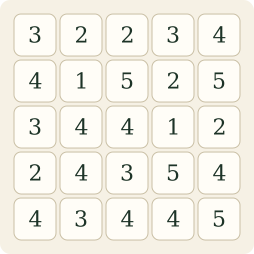
Hitori is played on a square grid of numbers. You shade some squares so that:
- No number appears more than once in any row or column among the squares left unshaded.
- Shaded squares never touch along an edge (corners are fine).
- The unshaded squares all join up into one connected piece.
A proper puzzle has exactly one answer. Everything below is available by deduction.
Move 1: the sandwich
When the same number sits on both sides of a different one, as in 2 5 2, the middle square can never be shaded. If it were, both 2s would be next to a shaded square, so neither could be shaded, and the row would hold two unshaded 2s. Mark the middle one as safe (circle it).

Move 2: the triple
Three equal numbers in a row, such as 4 4 4, can leave only one unshaded 4. Two must be shaded, and shaded squares cannot touch, so it has to be the outer two. The middle 4 is safe.

Move 3: the pair
Two equal numbers side by side mean exactly one of them must be shaded (never both: they would touch). That does not tell you which, but it tells you something else: every other copy of that number in the line the pair sits in is shaded, because one unshaded copy already exists in the pair. For a pair side by side in a row, that means the rest of that row; for a pair stacked in a column, the rest of that column. Copies in the other direction are not affected, since you do not yet know which square of the pair stays unshaded.
Move 4: the connectivity check
Whenever you shade a square, circle all of its neighbors, since they must stay unshaded. Then ask the opposite question about every shaded square: does it cut off a corner or split the board? If a shade would leave an unshaded square, or a group of them, sealed off from the rest, it breaks the connectivity rule, so that square cannot be shaded. Most late-game deductions are this check.
Try a real one
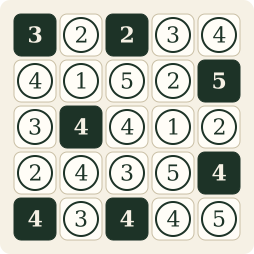
Here is a 5x5 generated and checked by program, so it has exactly one solution. Look at the top row first: the two 2s sit side by side, so one of them has to go (Move 3). Work outward from there.
Click the board to play it. The solution is tucked below if you get stuck. Shaded squares are dark; the rest are circled.
Show the solution
Habits that help
- Use a circle for "safe" (click a square twice), a fill for "shaded" (click once).
- After each shade, update the neighbors before you look for the next move.
- If a row seems to need two incompatible shades, an earlier mark is wrong. Back up to the last certain move.
The Hitori app has a hands-on tutorial that walks through these moves on tiny boards, one idea at a time.
Related articles
Help Me Choose a Game
Not sure which logic puzzle to try? Answer two or three quick questions and get a suggestion from Hitori, Nurikabe, Norinori and Shikaku.
Read more
Hitori, Nurikabe or Norinori: Which Should You Learn First?
Three shade-the-squares puzzles, three different ways of thinking. How they compare, and which one to start with depending on how you like to solve.
Read more
Hitori, Nurikabe and Norinori: Three Puzzles from Japan
Where the names come from and when each puzzle first appeared in print. All three are shade-the-squares puzzles from the Japanese publisher Nikoli.
Read more
Comments (0)
No comments yet.