Five Habits of Careful Logic-Puzzle Solvers
Good logic puzzles share a promise: there is one solution, and you can reach it by deductive reasoning. These habits follow from that promise.
1. Trust the uniqueness
If a puzzle is well made, a square that "could go either way" has not been decided yet. Look elsewhere and come back. The answer will arrive from another part of the board.
2. Mark certainties, not hunches
Use one mark for "definitely yes" and another for "definitely no." For "maybe," most online puzzles have a "dot" option for squares that means maybe.
3. Re-scan after every move
Each new mark can unlock squares you already checked. A quick scan of the neighbors of the square you just placed finds the next move far more often than rereading the whole board.
4. Look for what a rule forbids
The strongest deductions come from "this would break the rules": a shaded square here would trap that one, a block there would make a shape too big. Try the opposite of what you want and see whether it fails.
5. Back up to the last certainty
When you hit a contradiction, an earlier mark is wrong. Do not patch the symptom - go back to the last move you proved, and everything after it is suspect.
Practice on small boards
All three of our apps start with a short guided tutorial on tiny boards and build up to 10x10. Small grids teach the patterns and the knowledge helps with large ones.
Related articles
Do Puzzles Keep Your Brain Sharp? What the Research Actually Says
People who do puzzles score better on thinking tests, but that does not prove puzzles cause it. A plain-language look at what studies of crosswords, Sudoku and brain-training games do and do not show.
Read moreHelp Me Choose a Game
Not sure which logic puzzle to try? Answer two or three quick questions and get a suggestion from Hitori, Nurikabe, Norinori and Shikaku.
Read more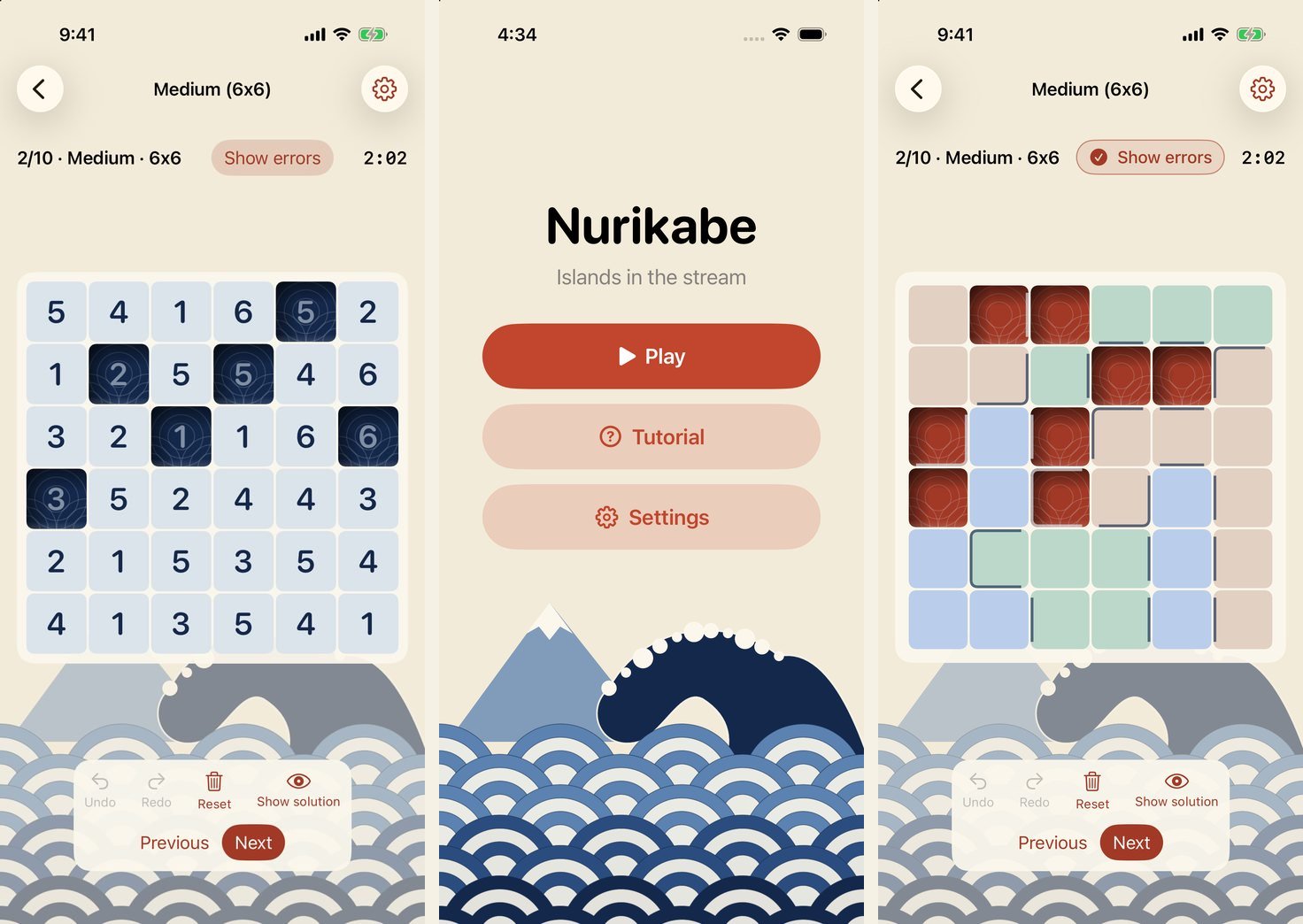
Hitori, Nurikabe or Norinori: Which Should You Learn First?
Three shade-the-squares puzzles, three different ways of thinking. How they compare, and which one to start with depending on how you like to solve.
Read more
Comments (0)
No comments yet.